Femur Force
Overview
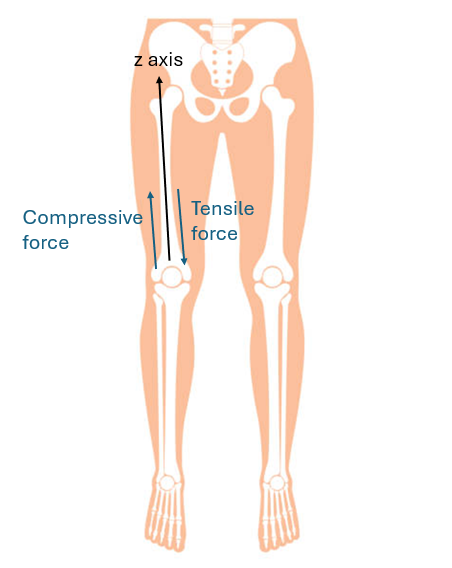
Femur Force represents the maximum compressive force exerted on the femur during an impact or collision event [1]. If the ATD used in testing has an established Injury Assessment Reference Value (IARV), the peak femur compression is reported as a percentage of that IARV to indicate potential injury severity [2]. The IARV represents a threshold value used to evaluate the risk of injury during an impact, each ATD has their own IARV value depending on the type, sex, and size of the dummy [2].
Required Signals
- Left/Right Femur Force (Z)
Calculation
- Convert femur force to newtons (N) (if applicable)
- Filter femur force signal (CFC = 600)
- Truncate signal to start at 0 seconds (if applicable)
- Find the minimum femur force (the maximum compressive force)
- Calculate the percent of the IARV that the minimum femur force reaches
NCAP Combined Injury Rating
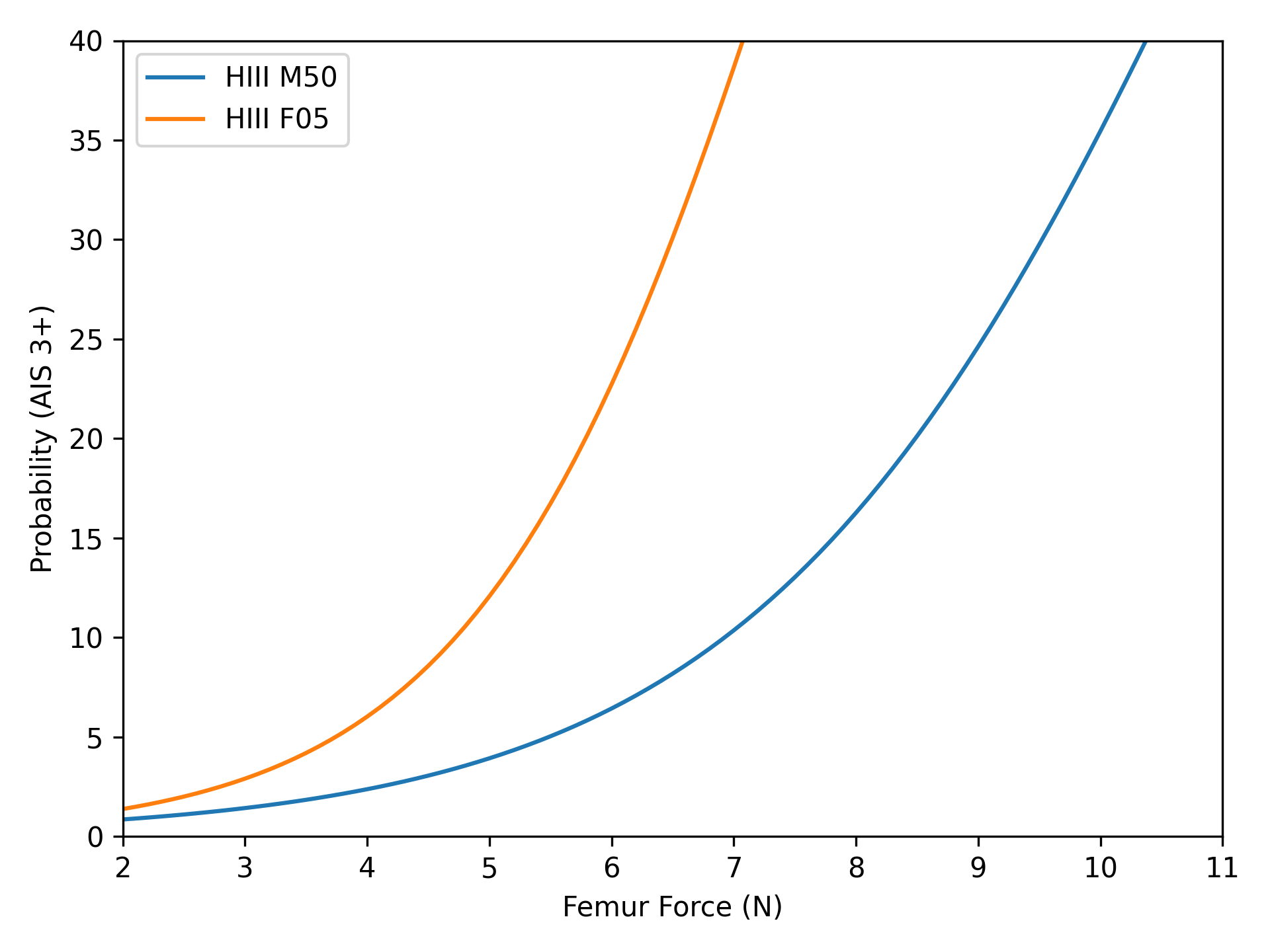
The femur force metric is used in the NCAP frontal impact for the HIII M50 and HII F05 dummies.
Femur Compression Injury Risk Value [4] [5] [6]
| ATD | Femur Compression Injury Risk Value (N) |
|---|---|
| HIII - F05 | -6805 |
| HIII - M50 | -10,008 |
| HIII - M95 | -12,700 |
| THOR - M50 | -10,577 |
References
[1] AlTurki AA, AlAqeely KS, AlMugren TS, AlZimami IS. Analysis of femoral fracture post motor vehicle accidents. Saudi Med J. 2019 Jan;40(1):41-44.
[2] "Frontal Offset Crashworthiness Evaluation". Guidelines for Rating Injury Measures, Insurance Institute for Highway Safety, June 2009.
[3] National Highway Traffic Safety Administration. Final Rule; Response to Petitions for Reconsideration: Federal Motor Vehicle Safety Standards; Head Restraints. Docket No. NHTSA-2006-26555-0120, U.S. Department of Transportation, 2006.
[4] National Highway Traffic Safety Administration. (2000). Federal Motor Vehicle Safety Standards; Occupant Crash Protection; Final Rule. Federal Register, 65(208), 67691–67703.
[5] Craig, M., et al. "Injury criteria for the THOR 50th male ATD." National Highway Traffic Safety Administration (2020).
[6] Bandak, Faris, et al. "Development of improved injury criteria for the assessment of advanced automotive restraint systems: II." (1999).