Abdomen Force
Description
Abdomen force is defined for the EuroSID anthropomorphic test device (ATD), which incorporates three uniaxial force transducers in the Y-axis direction within the abdominal cavity. These transducers quantify lateral abdominal loading during side impacts and support evaluation of abdominal injury risk [1].
This metric does not have a separate button. WebSAT reports abdomen force and its injury risk when you select Vehicle Analysis > NCAP for a supported side moving-deformable-barrier test.
Measurements used by WebSAT
- Abdomen 1 Force, Abdomen 2 Force, and Abdomen 3 Force (Y) in the EuroSID Dummy
How WebSAT processes the data
- Filter all signals (CFC 600)
- Sum the 3 force signals
- Calculate the peak of the sum of abdomen forces and corresponding time
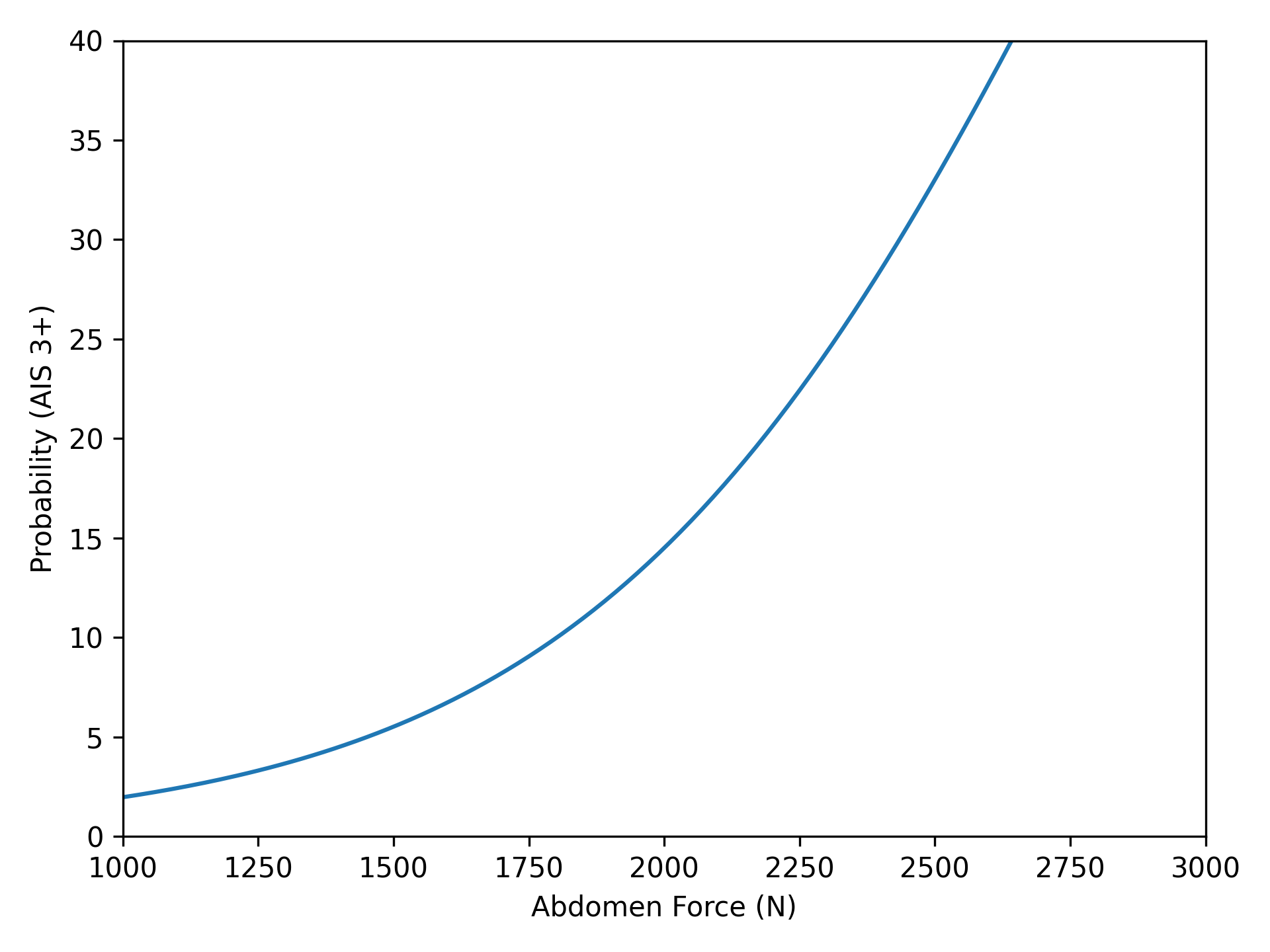
- Use the peak force to calculate the NCAP AIS 3+ abdominal-injury risk.
NCAP injury risk
The abdomen force metric is used for the driver in the NCAP side moving-deformable-barrier test. NHTSA defines the AIS 3+ abdominal-injury risk relationship as follows [2]:
References
[1] van Ratingen, Michiel. Development and evaluation of the ES-2 side impact dummy. No. 2001-06-0050. SAE Technical Paper, 2001.
[2] National Highway Traffic Safety Administration. New Car Assessment Program; Suggested Approaches for Enhancements. 73 FR 40016, July 11, 2008, Appendix D.