Head Injury Criterion (HIC)
Description
The Head Injury Criterion (HIC) measures the severity of translational head acceleration over the most severe interval of a specified maximum duration. WebSAT also reports the Skull Fracture Correlate (SFC) over the HIC interval and associated injury probabilities [1] [2].
When this feature is available
HIC becomes available when either the current curve selection or any loaded test contains a head-acceleration measurement set that meets the requirements. Only channels with a usable data status count.
The required measurement set contains either:
- One resultant head-acceleration channel with units
G'S; or - All three component channels at the same head location:
- Axis:
X - LOCAL, Units:G'S - Axis:
Y - LOCAL, Units:G'S - Axis:
Z - LOCAL, Units:G'S
- Axis:
The signal attachment may be HEAD CG or HEAD 9 ARRAY - CENTER. WebSAT checks each occupant or test subject independently, prefers the three component channels when both input paths are available, and prioritizes channels marked PRIMARY.
Settings
| Setting | Default | Options |
|---|---|---|
| Filter Input Signal(s) | On | On or off |
| Filter CFC | 1000 | 60, 180, 600, or 1000 |
| HIC Window | 15 ms | 15 ms or 36 ms |
How WebSAT processes the data
- Load the resultant acceleration or calculate it from X, Y, and Z components.
- Apply the selected filter when enabled and express acceleration in g and time in seconds.
- Search all intervals no longer than the selected HIC window for the maximum value:
- Report the governing interval and calculate SFC from the average acceleration over that interval.
- Evaluate the available AIS 2+ and AIS 3+ HIC risk functions and the SFC skull-fracture probability.
Reference values and injury risk
The ATD-specific HIC values below follow the published IARVs and the applicable FMVSS performance limits for adult and child dummies [3] [4] [5].
| ATD | HIC15 IARV | HIC36 IARV |
|---|---|---|
| Q3s | 570 | — |
| CRABI 6-month | 377 | — |
| CRABI 12-month | 390 | 1000 |
| CRABI 18-month | 440 | — |
| Hybrid III 3-year-old | 570 | 1000 |
| Hybrid III 6-year-old | 700 | 1000 |
| Hybrid III 10-year-old | 741 | — |
| Hybrid III 5th female | 700 | — |
| Hybrid III 50th male | 700 | 1000 |
| Hybrid III 95th male | 670 | — |
| SID-IIs | 779 | 1000 |
| BioSID | 700 | — |
| ES-2re | — | 1000 |
ATDs without a populated HIC15 or HIC36 value do not receive an ATD-specific HIC reference value. The risk probabilities can still be calculated from the HIC result because the risk relationships are not ATD-specific.
WebSAT reports AIS 2+ and AIS 3+ probabilities from the HIC risk relationships used by NHTSA [6]:
SFC probability uses the logistic relationship published by Vander Vorst et al. [2].
Results

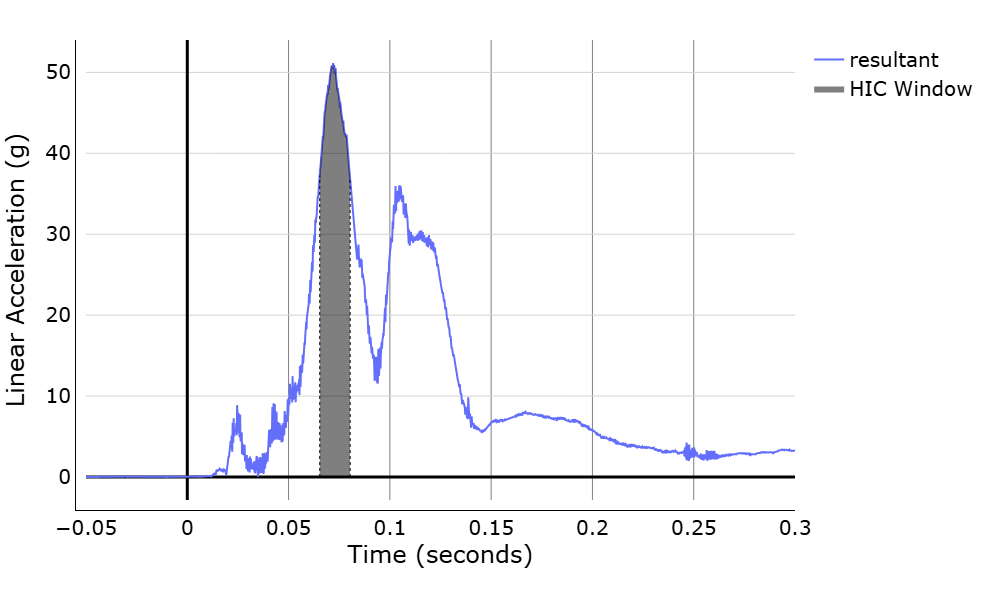
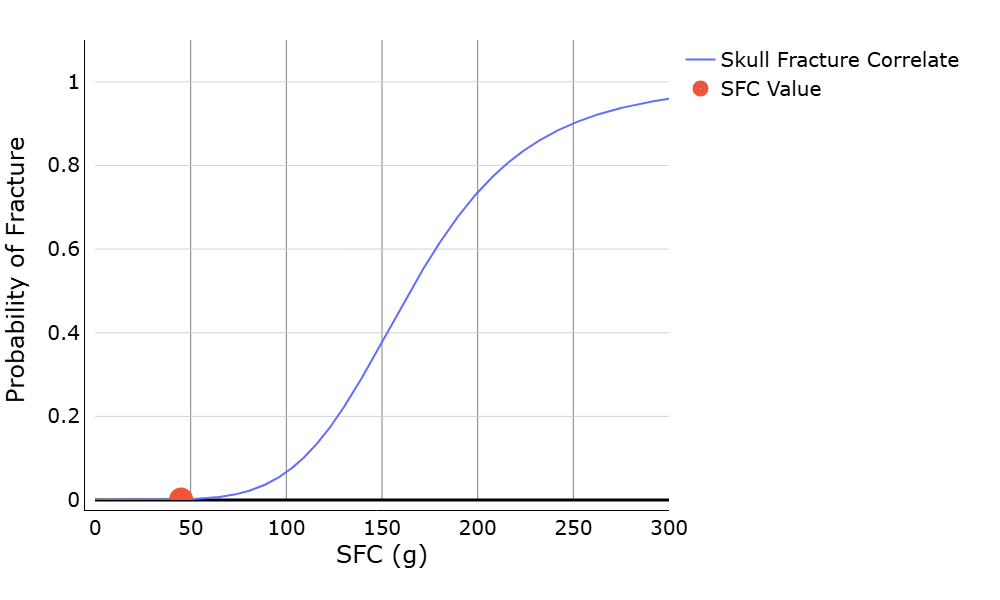
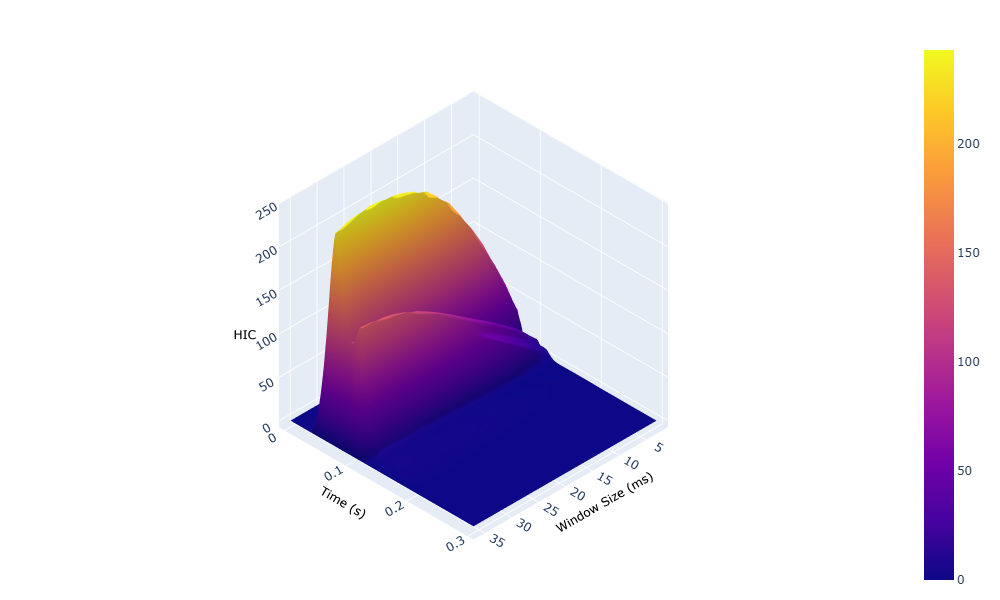
The summary table reports the subject, HIC value, interval start and end, and skull-fracture risk. The result plots show the resultant acceleration with the governing HIC window, the HIC and SFC injury-risk relationships, and the three-dimensional head-acceleration trajectory.
References
[1] Hertz, E. “A Note on the Head Injury Criterion (HIC) as a Predictor of the Risk of Skull Fracture.” 37th Annual Proceedings of the Association for the Advancement of Automotive Medicine, 1993.
[2] Vander Vorst, M. et al. “Statistically and Biomechanically Based Criterion for Impact-Induced Skull Fracture.” Annual Proceedings of the Association for the Advancement of Automotive Medicine, 47, 2003, pp. 363–381.
[3] Mertz, H. J. “Anthropomorphic Test Devices.” In Accidental Injury: Biomechanics and Prevention. Springer, 1993, pp. 66–84.
[4] National Highway Traffic Safety Administration. “Federal Motor Vehicle Safety Standards; Occupant Crash Protection; Final Rule.” Federal Register, 65(208), 2000, pp. 67691–67703.
[5] National Highway Traffic Safety Administration. 49 CFR § 571.213b—Child Restraint Systems.
[6] National Highway Traffic Safety Administration. Evaluation of Belted and Unbelted Safety Requirements. DOT HS 812 232, 2015.