FMVSS 208 neck loads (208Neck)
Description
208Neck evaluates an individual neck force or bending-moment channel against the available ATD-specific assessment reference values. Unlike Nij, it reports axial, shear, and bending responses separately [1] [2].
When this feature is available
208Neck becomes available when either the current curve selection or any loaded test contains a neck measurement set that meets the requirements. Only channels with a usable data status count.
The required measurement set includes:
- The signal attachment must be
NECK - UPPERorNECK - LOWER. - The group must contain at least one of the following channels:
- Axis:
X - LOCAL, Units:NEWTONSfor forward/rearward shear - Axis:
Z - LOCAL, Units:NEWTONSfor tension/compression - Axis:
Y - LOCAL, Units:NEWTON-METERSfor flexion/extension
- Axis:
WebSAT checks each occupant and neck location independently and enables 208Neck if any eligible measurement set contains at least one supported load channel. A group can produce a partial result when only some load types are present.
Settings
This feature has no settings.
How WebSAT processes the data
- Identify each supported neck-force or neck-moment channel in the qualifying measurement set.
- Convert the channels to standard force or moment units.
- Determine the load type and direction from the axis, units, and signal polarity.
- Apply the appropriate impact-test filtering.
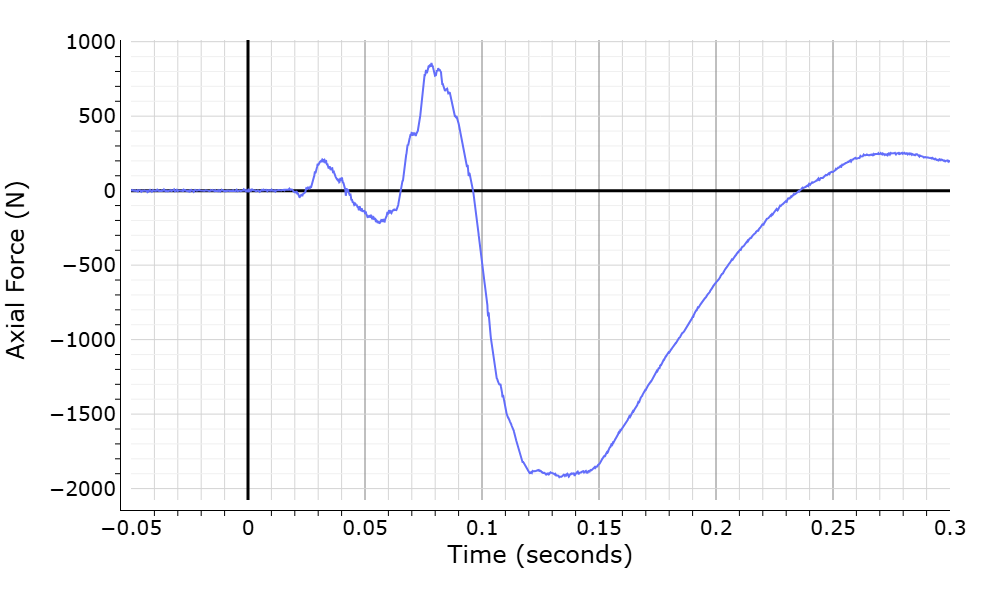
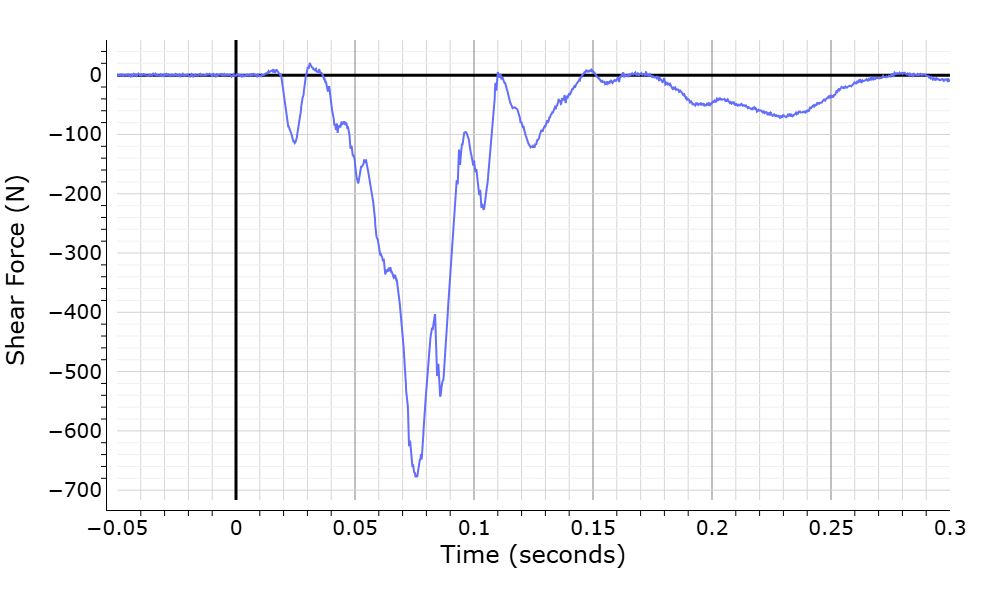
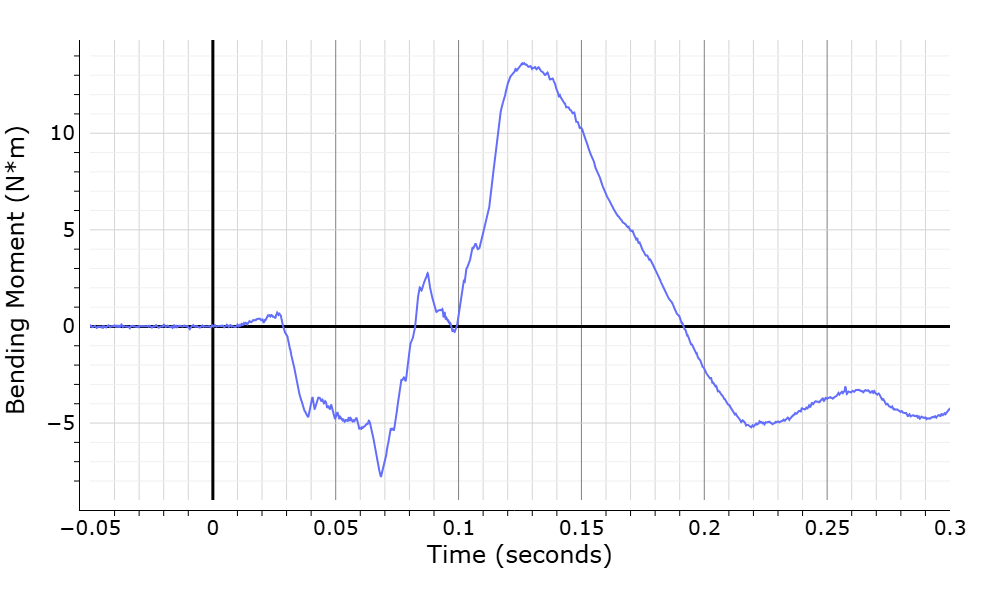
- Find the positive and negative peaks for every available load type.
- Attach the available ATD-specific critical value to each result.
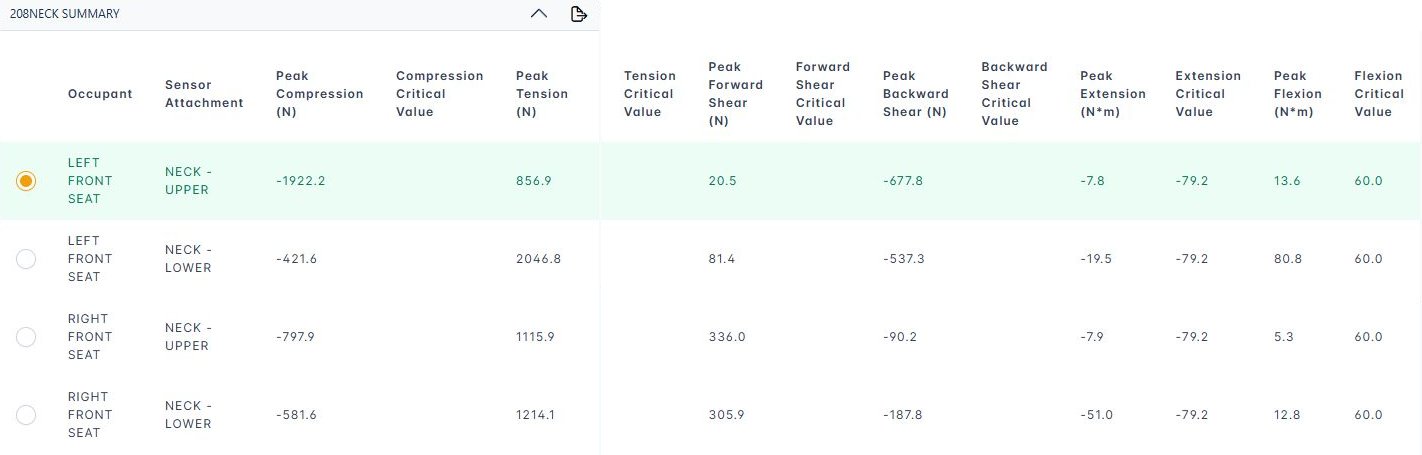
- Report the available shear, axial-force, and bending-moment results for the occupant and neck location.
Reference values and injury risk
The current 208Neck calculation uses the upper-neck fields shown below. Axial force uses the upper-neck tension and compression limits, shear uses the upper-neck shear limit in both directions, and bending moment uses the upper-neck Nij flexion and extension critical intercepts. The values follow the FMVSS 208 and published ATD injury-assessment definitions [1] [2]. A dash means the selected ATD does not provide that reference value, so WebSAT reports the peak without a percent-of-reference comparison for that direction.
| ATD | Tension (N) | Compression (N) | Shear, ± (N) | Flexion intercept (N·m) | Extension intercept (N·m) |
|---|---|---|---|---|---|
| Hybrid III 95th male | 5030 | -4830 | 3740 | 405 | -177 |
| Hybrid III 50th male | 4170 | -4000 | 3100 | 310 | -135 |
| Hybrid III 5th female | 2620 | -2520 | 1950 | 155 | -67 |
| Hybrid III 10-year-old | 2290 | -2200 | 1710 | 125 | -54.8 |
| Hybrid III 6-year-old | 1490 | -1820 | 1410 | 96 | -42 |
| Hybrid III 3-year-old | 1130 | -1380 | 1070 | 67 | -29.3 |
| CRABI 18-month | 1080 | -1040 | 810 | 46.8 | -20.4 |
| CRABI 12-month | 990 | -960 | 740 | 42.5 | -18.6 |
| CRABI 6-month | 930 | -890 | 690 | 39.5 | -17.3 |
| THOR 50th male | — | — | — | 60 | -79.2 |
| THOR 5th female | 4170 | -4000 | — | 88.1 | -117 |
| SID-IIs 5th female | 2620 | -2520 | 1950 | 153 | -66.9 |
| BioSID 50th male | — | — | 3100 | — | — |
These are the values WebSAT places beside the positive and negative result peaks. The function does not combine the loads or convert them into an AIS probability; use Nij when a combined axial-force/bending-moment assessment is required.
Results
References
[1] National Highway Traffic Safety Administration. “Federal Motor Vehicle Safety Standards; Occupant Crash Protection; Final Rule.” Federal Register, 65(208), 2000, pp. 67691–67703.
[2] Mertz, H. J., Irwin, A. L., and Prasad, P. “Biomechanical and Scaling Bases for Frontal and Side Impact Injury Assessment Reference Values.” Stapp Car Crash Journal, 47, 2003, pp. 155–188. SAE Technical Paper 2003-22-0009.