Combined Thoracic Injury (CTI)
Description
Combined Thoracic Injury (CTI) combines chest acceleration and chest deflection into one normalized measure for frontal-impact thoracic loading [1] [2].
When this feature is available
CTI becomes available when either the current curve selection or any loaded test contains a chest measurement set that meets the requirements. Only channels with a usable data status count.
The required measurement set includes:
- The occupant must not be a Hybrid III 10-year-old dummy.
- The signal attachment must be
CHEST. - The group must contain an X-axis displacement channel:
- Axis:
X - LOCALorX - GLOBAL, Units: millimeters
- Axis:
- The same group must contain all three acceleration components with units
G'S:- X-, Y-, and Z-local channels; or
- X-, Y-, and Z-global channels.
WebSAT checks each occupant independently and enables CTI if any eligible chest measurement set contains both the required displacement and complete acceleration set.
Settings
This feature has no settings.
How WebSAT processes the data
- Validate the chest displacement and three acceleration components for the occupant.
- Convert the inputs to standard acceleration and displacement units.
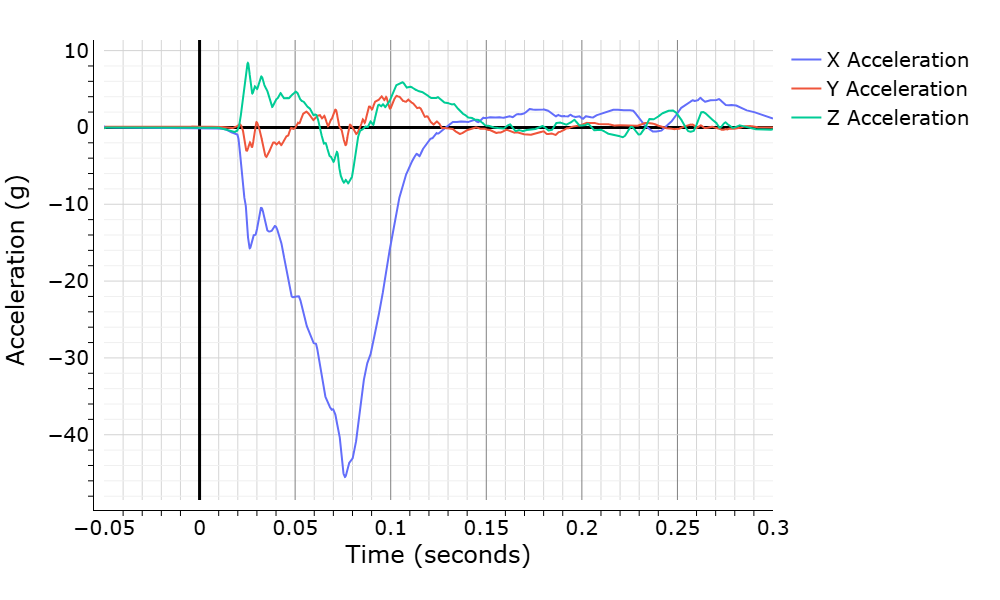
- Filter the three acceleration components at CFC 180.
- Calculate resultant chest acceleration.
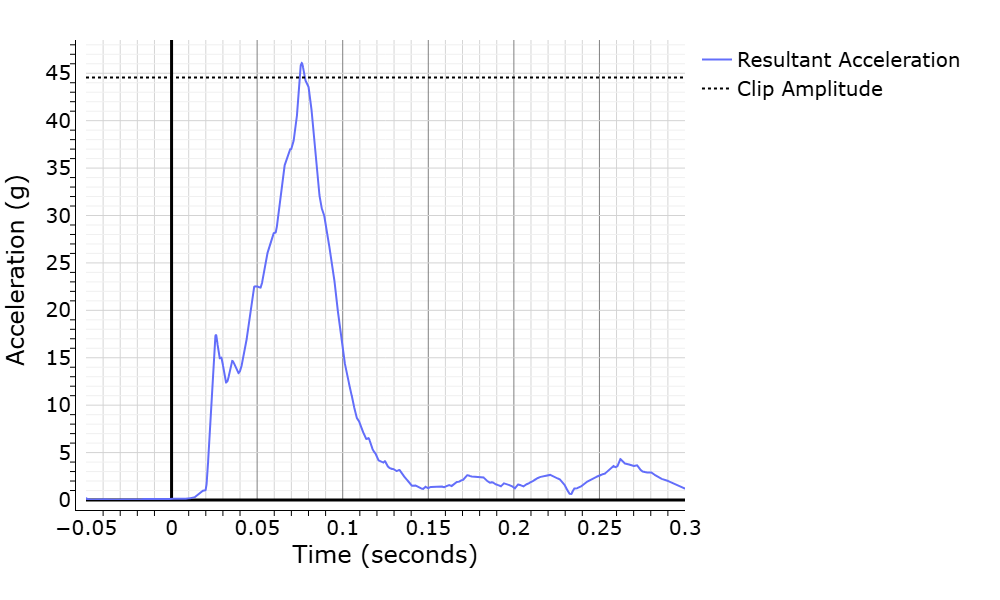
- Determine the resultant acceleration's 3 ms clip.
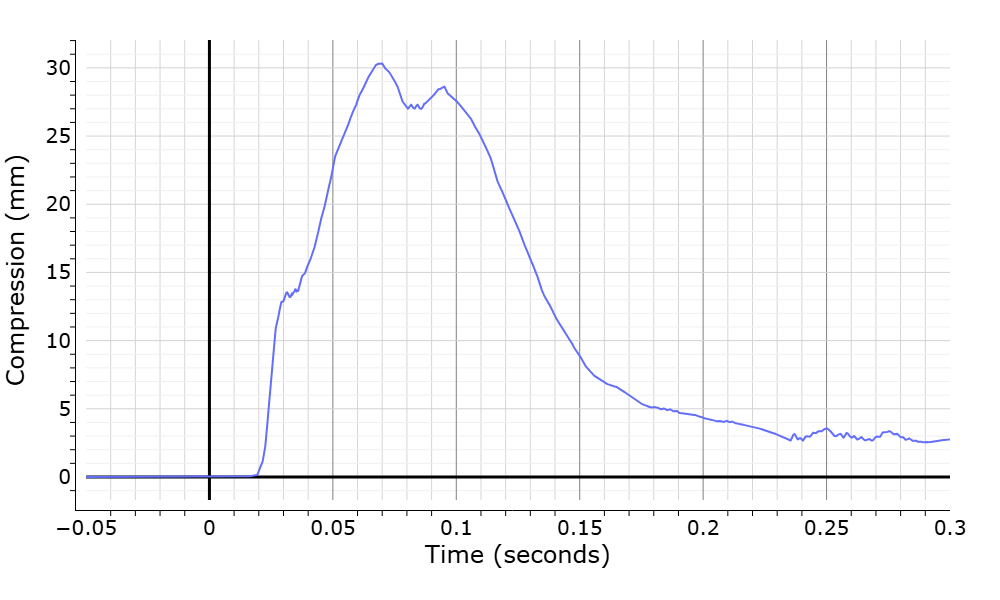
- Process chest displacement and find maximum chest deflection.
- Select the acceleration and deflection intercepts for the occupant's ATD.
- Calculate:
- Report CTI, the 3 ms acceleration clip, maximum chest displacement, and supporting plots.
Reference values and injury risk
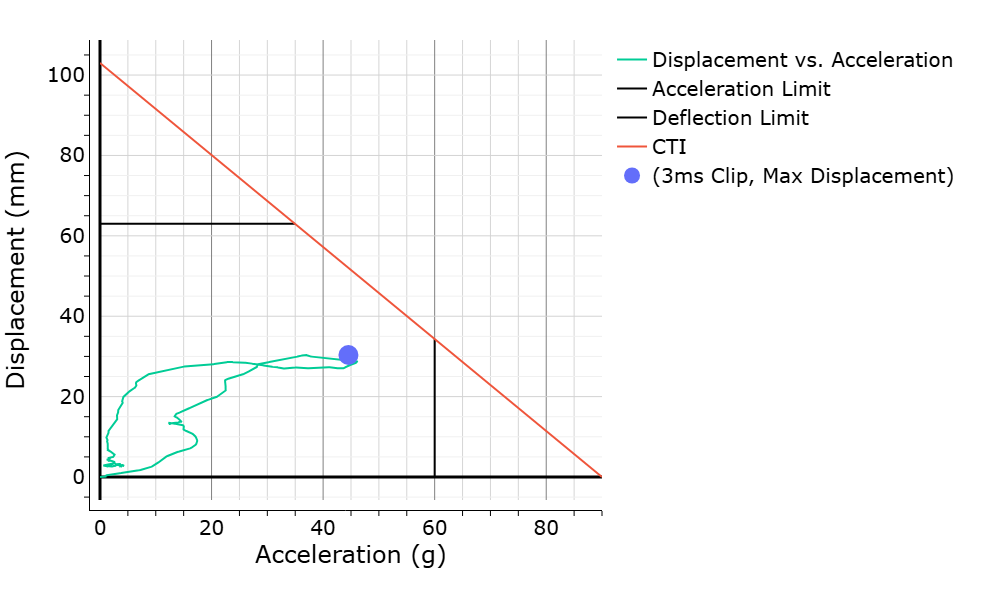
CTI intercepts
The CTI intercepts are taken from the NHTSA advanced-restraint injury-criteria work [1] [2] [3].
| ATD | Acceleration intercept (g) | Deflection intercept (mm) |
|---|---|---|
| Hybrid III 95th male | 83 | 114 |
| Hybrid III 50th male | 90 | 103 |
| Hybrid III 5th female | 90 | 84 |
| Hybrid III 6-year-old | 90 | 64 |
| Hybrid III 3-year-old | 74 | 57 |
| CRABI 12-month | 57 | 50 |
Component assessment limits
The component limits are the corresponding ATD-scaled chest-acceleration and chest-deflection assessment values [1] [2].
| ATD | Chest acceleration (g) | Chest deflection (mm) |
|---|---|---|
| Hybrid III 95th male | 55 | 70 |
| Hybrid III 50th male | 60 | 63 |
| Hybrid III 5th female | 60 | 52 |
| Hybrid III 6-year-old | 60 | 40 |
| Hybrid III 3-year-old | 55 | 34 |
| CRABI 12-month | 50 | 30 |
WebSAT reports CTI and its two component values. This function does not convert CTI into a separate AIS probability.
Results
The result summary identifies the test and occupant and reports CTI, the 3 ms resultant chest-acceleration clip, and maximum chest displacement. The CTI plot places the measured acceleration and displacement against the CTI and component limits. Supporting plots show the processed signals used in the result.

References
[1] Eppinger, R. et al. Development of Improved Injury Criteria for the Assessment of Advanced Automotive Restraint Systems. National Highway Traffic Safety Administration, 1998.
[2] Eppinger, R. et al. Supplement: Development of Improved Injury Criteria for the Assessment of Advanced Automotive Restraint Systems: II. National Highway Traffic Safety Administration, 2000.
[3] Bandak, F. et al. Development of Improved Injury Criteria for the Assessment of Advanced Automotive Restraint Systems: II, 1999.