Viscous Criterion (VC)
Description
The Viscous Criterion combines thorax compression and compression velocity to represent soft-tissue injury loading. WebSAT provides four calculation methods because test procedures differ in how compression velocity is obtained [1] [2] [3].
When this feature is available
VC becomes available when either the current curve selection or any loaded test contains a thorax measurement set that meets the requirements for the selected method. Only channels with a usable data status count.
The required measurement set includes:
- The occupant must not be a Hybrid III 10-year-old dummy.
- The group must contain at least one deflection channel in millimeters attached at the chest, sternum, or an upper/middle/lower rib location.
- If the selected method is
SAE J1727 1orDirective 96/27/EC, the deflection channel is sufficient. - If the selected method is
SAE J1727 2orSID 2S, the same occupant group must also contain:- An acceleration channel with units
G'Sat the chest, sternum, or rib location; and - An acceleration channel with units
G'SatSPINE - UPPERorSPINE - LOWER.
- An acceleration channel with units
WebSAT checks each occupant and thorax location independently and enables VC if any eligible measurement set satisfies the requirements of the currently selected method.
Settings
The button's dropdown selects the method. The default is Directive 96/27/EC.
| WebSAT option | Method |
|---|---|
| SAE J1727 1 | Differentiate filtered deflection |
| SAE J1727 2 | Integrate chest and spine acceleration separately, then subtract velocity |
| Directive 96/27/EC | EC deflection/differentiation method |
| SID 2S | Subtract chest and spine acceleration, then filter and integrate |
How WebSAT processes the data
- Validate the thorax channels required by the selected VC method.
- Convert deflection and acceleration inputs to consistent units.
- Process compression velocity according to the selected method:
SAE J1727 1: filter deflection at CFC 600 and differentiate it.SAE J1727 2: filter deflection and accelerations at CFC 600, integrate chest and spine acceleration separately, and subtract the velocities.Directive 96/27/EC: filter deflection at CFC 180 and use a 0.140 m normalization.SID 2S: subtract chest and spine acceleration, filter the difference at CFC 600, and integrate it.
- Select the method-specific scale factor and chest-depth normalization.
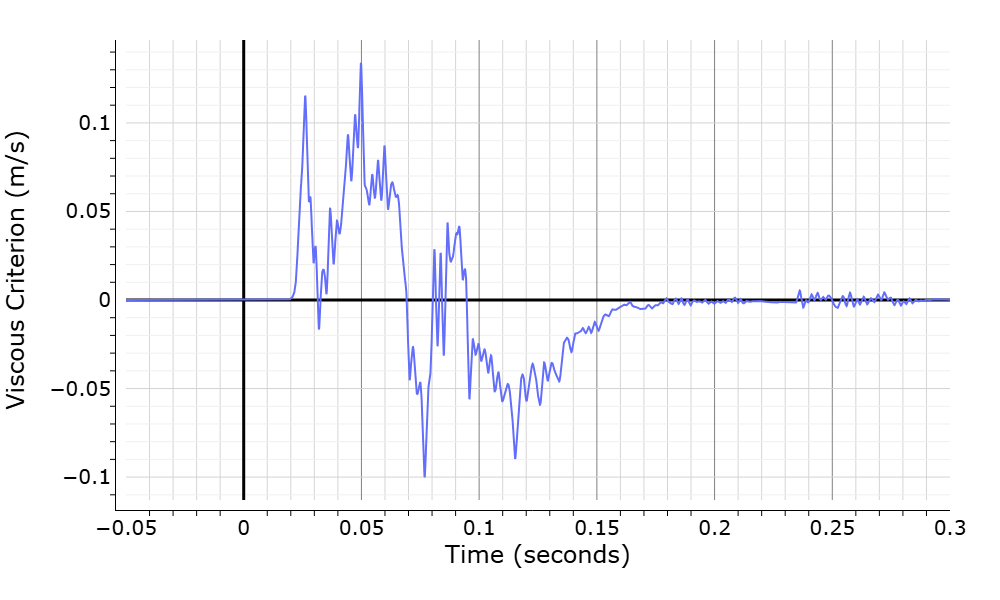
- Calculate VC at every time sample:
Here, is chest compression, is compression velocity, is the ATD scale factor, and is chest depth or half-width.
- Find the peak VC and its time.
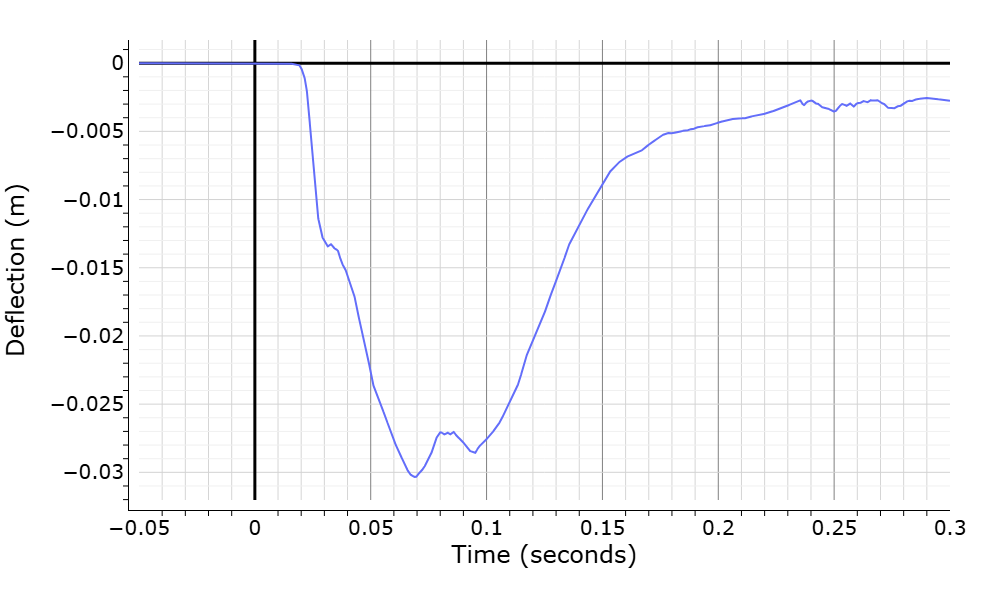
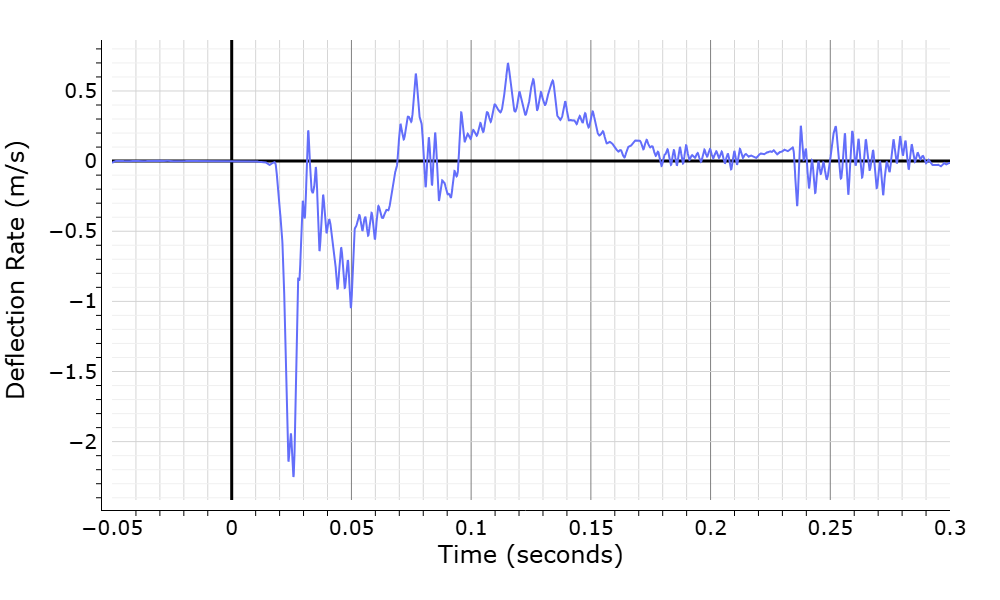
- Report the selected method, peak VC, and supporting deflection and deflection-rate histories.
Reference values and injury risk
| ATD | Scale factor | Normalization (mm) |
|---|---|---|
| Hybrid III 95th male | 1.3 | 254 |
| Hybrid III 50th male | 1.3 | 229 |
| Hybrid III 5th female | 1.3 | 187 |
| Hybrid III 6-year-old | 1.3 | 143 |
| Hybrid III 3-year-old | 1.3 | 122 |
| SID-IIs | 1.0 | 138 |
| ES-2re | 1.0 | 140 |
| EuroSID | 1.0 | 140 |
Not every row applies to every method. SAE J1727 supplies ATD scaling; the EC and SID 2S methods use the normalization defined by the European side-impact requirements [4]. A commonly used VC assessment reference is 1.0 m/s; the cited IIHS rating boundaries are 0.8, 1.0, and 1.2 m/s for good/acceptable, acceptable/marginal, and marginal/poor transitions [3]. WebSAT reports VC but does not report an AIS probability for this function.
Results
The results identify the occupant, calculation method, input attachment, and peak VC. WebSAT also displays the processed VC, chest-deflection, and chest-deflection-rate histories used to calculate that peak.

References
[1] SAE International. Calculation Guidelines for Impact Testing. SAE Recommended Practice J1727.
[2] Lau, I. V. and Viano, D. C. “The Viscous Criterion—Bases and Applications of an Injury Severity Index for Soft Tissues.” SAE Transactions, 1986, pp. 672–691.
[3] Insurance Institute for Highway Safety. Frontal Offset Crashworthiness Evaluation—Guidelines for Rating Injury Measures, 2009.
[4] European Parliament and Council. Directive 96/27/EC on the Protection of Occupants of Motor Vehicles in the Event of a Side Impact, 1996.