Mertz
Overview
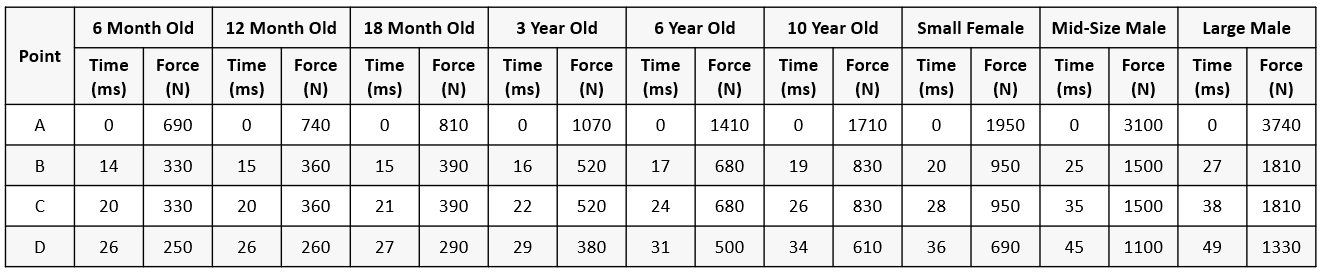
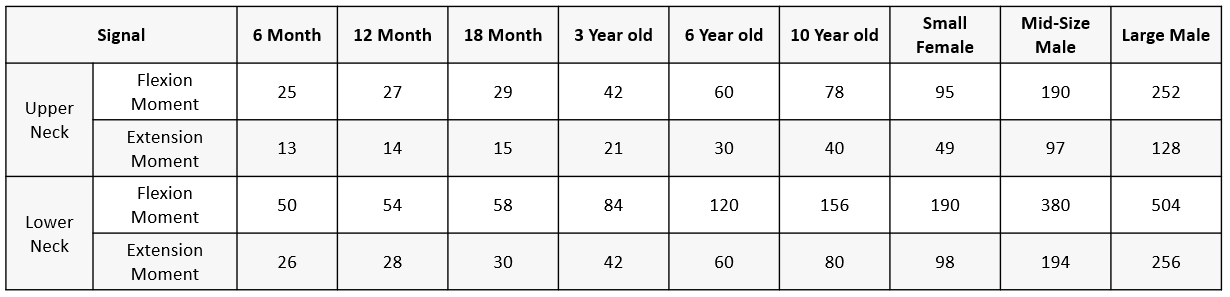
The Mertz scaling method, developed by H.J. Mertz, is used to normalize injury thresholds across different body sizes and populations [1]. These thresholds, derived from cadaver data, are scaled to apply to crash test dummies of various sizes [1]. In the tables below, the Mertz scaling method was applied to generate neck injury criteria (Nij intercept values) for subjects ranging from a 6-month-old infant to a large adult male [2].
Required Signals
- Forward/Rear Force of Neck (N) (X)
- Tension/Compression Force of Neck (N) (Z)
- Flexion/Extension Moment of Neck (N-m) (Y)
Calculation
- Filter force (CFC = 1000) or moment (CFC = 600)
- Computer IARV using comparison curve
Injury Criteria
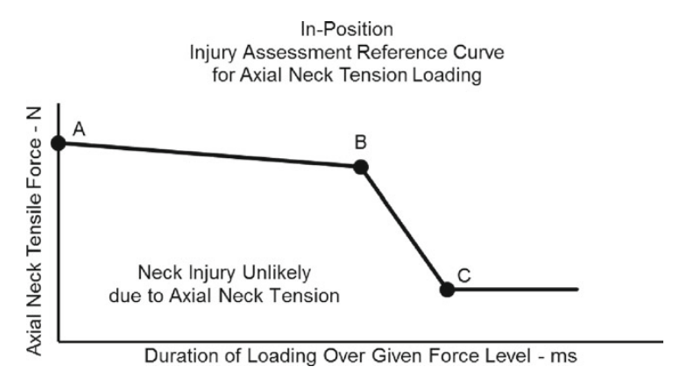
Neck Injury Tension Injury Assessment Reference Curve - In-Position

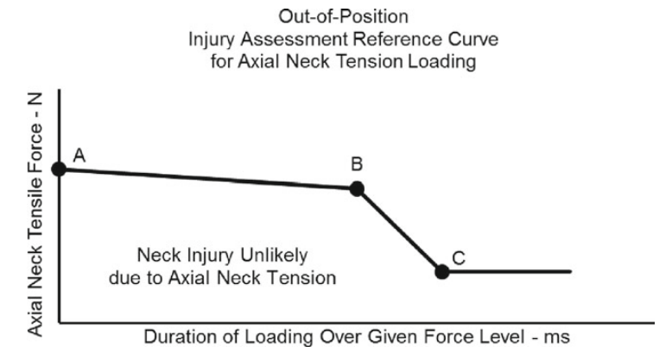
Neck Injury Tension Assessment Reference Curve - Out-of-Position

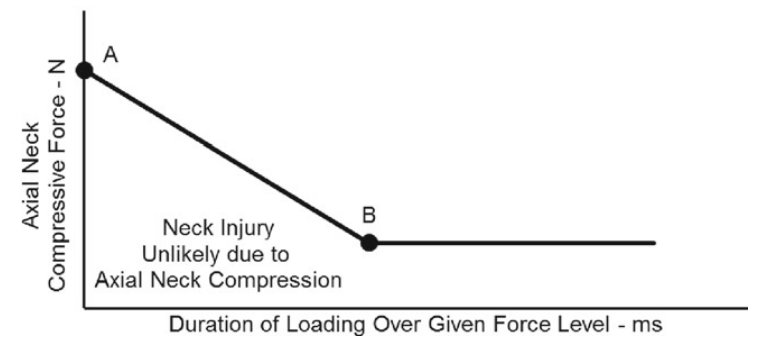
Neck Injury Compression Reference Curve

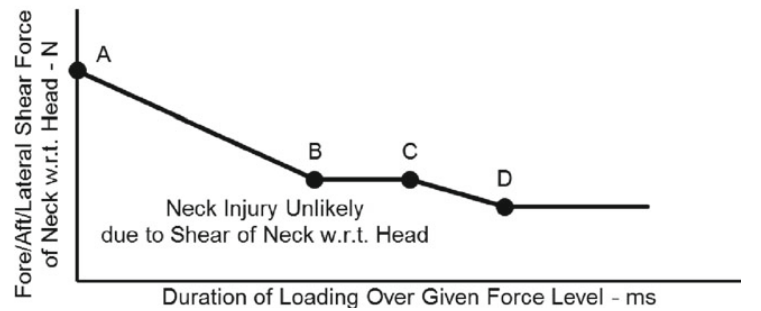
Neck Injury Shear Reference Curve
Neck Injury Flexion-Extension Reference Table - In-Position
Neck Injury Flexion-Extension Reference Table - Out-of-Position
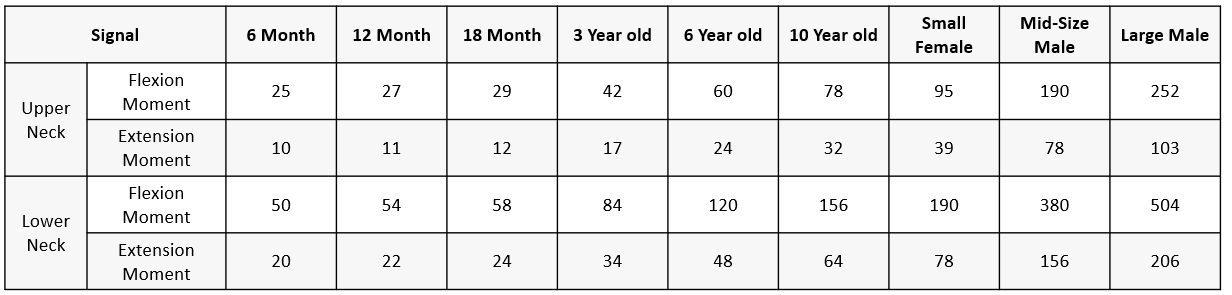
In position testing refers to crash testing where the ATD is properly seated and restrained, similar to a typical driving scenario [3]. Out of position testing refers to crash testing where the ATD may be in a non-seated posture or have shifted from their seat [3].
References
[1] Mertz, H.J., Irwin, A.L., & Prasad, P. (2003). Biomechanical and scaling bases for frontal and side impact injury assessment reference values. Stapp Car Crash Journal, Vol. 47.
[2] Mertz, Harold J. "Anthropomorphic test devices." Accidental injury: Biomechanics and prevention. New York, NY: Springer New York, 1993. 66-84.
[3] "Guidelines for Using the UMTRI ATD Positioning for ATD and Seat Positioning (Version I)". Insurance Institute for Highway Safety, January 2003.