Ankle Rotation
Description
Ankle Rotation describes the rotational response of the left or right ankle about its three local axes. It is a kinematic summary that can help identify excessive or unusual joint motion [1].
When this feature is available
Ankle Rotation becomes available when either the current curve selection or any loaded test contains an ankle measurement set that meets the requirements. Only channels with a usable data status count.
The required measurement set includes:
- The signal attachment must be
ANKLE - LEFTorANKLE - RIGHT. - The same group must contain all three rotation channels:
- Axis:
X - LOCAL, Units: degrees - Axis:
Y - LOCAL, Units: degrees - Axis:
Z - LOCAL, Units: degrees
- Axis:
WebSAT checks each ankle independently and enables Ankle Rotation if any left- or right-side measurement set contains the complete three-axis set.
Settings
This feature has no settings.
How WebSAT processes the data
- Validate the complete X-, Y-, and Z-rotation set for the ankle.
- Convert all three rotation channels to degrees.
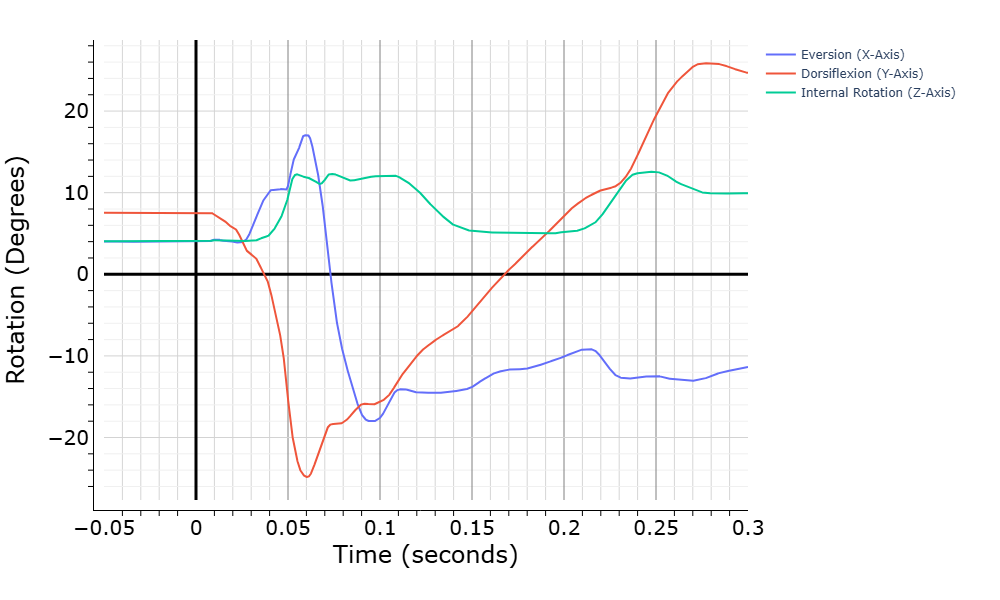
- Filter each channel at CFC 180.
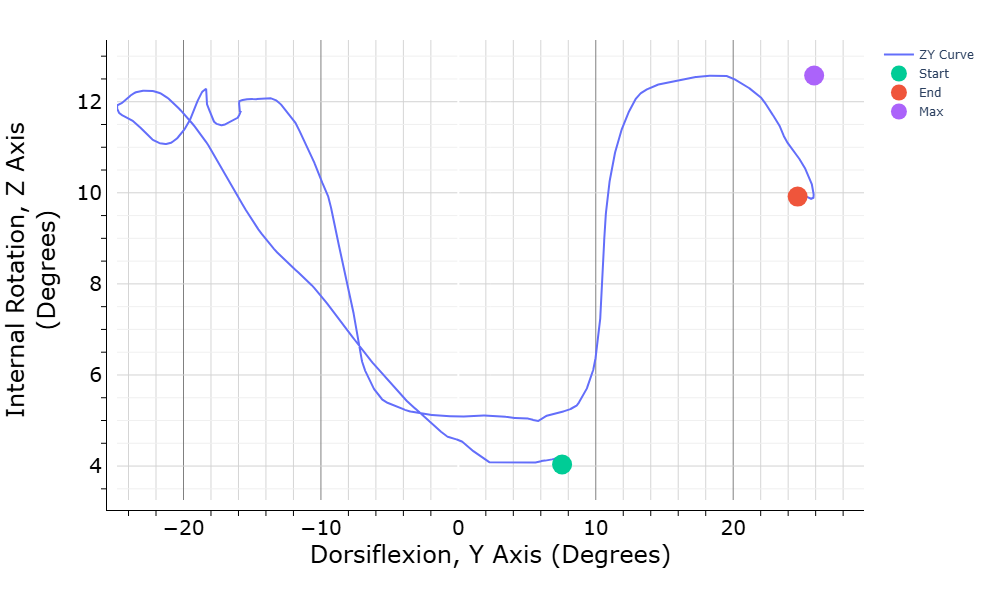
- Record the starting and finishing position about each axis.
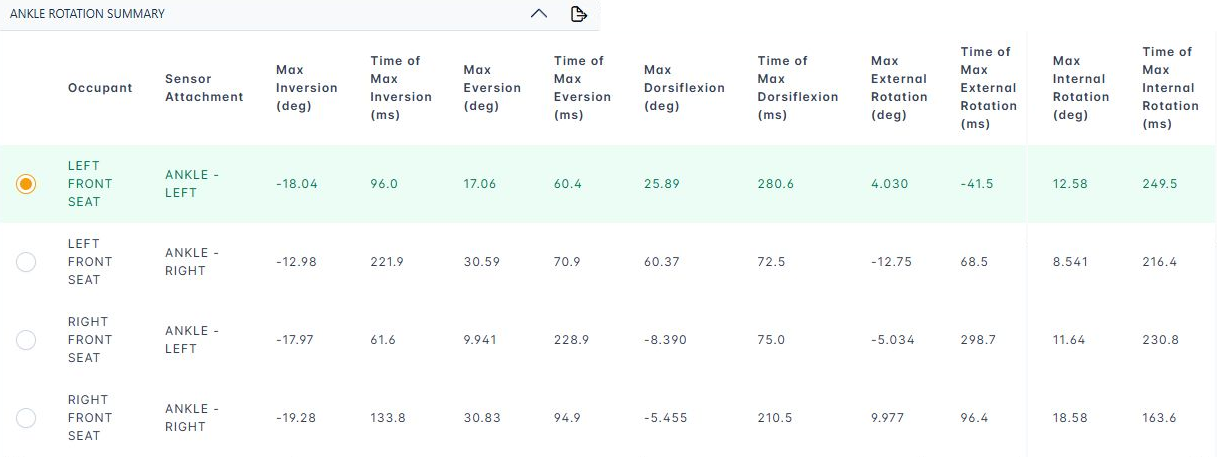
- Find the maximum and minimum X, Y, and Z rotations and their times.
- Report the six extrema and the processed rotation histories for the qualifying ankle.
Reference values and injury risk
WebSAT does not apply an ankle-rotation IARV or AIS risk function to this result. Interpret the rotations using the requirements of the governing test protocol or study.
Results
The summary contains six extrema—maximum and minimum X, Y, and Z rotation—for each qualifying ankle. Detail plots show all three filtered rotation histories.
References
[1] Funk, J. “Ankle Injury Mechanisms: Lessons Learned from Cadaveric Studies.” Clinical Anatomy, 24(3), 2011.