Tibia Index (TI)
Description
The Tibia Index combines axial force and resultant bending moment at an upper or lower tibia load cell. It represents combined compression/bending loading in frontal-impact lower-leg assessment [1] [2].
When this feature is available
Tibia Index becomes available when either the current curve selection or any loaded test contains a tibia measurement set that meets the requirements. Only channels with a usable data status count.
The required measurement set includes:
- The signal attachment must be a supported left or right upper- or lower-tibia location.
- The same attachment measurement set must contain all three required channels:
- Axis:
X - LOCAL, Units:NEWTON-METERS - Axis:
Y - LOCAL, Units:NEWTON-METERS - Axis:
Z - LOCAL, Units:NEWTONS
- Axis:
WebSAT checks each tibia attachment independently and enables Tibia Index if any supported measurement set contains the complete force-and-moment set.
Settings
| Setting | Default | Effect |
|---|---|---|
| Apply Filter | On | Filters force and moments at CFC 600 |
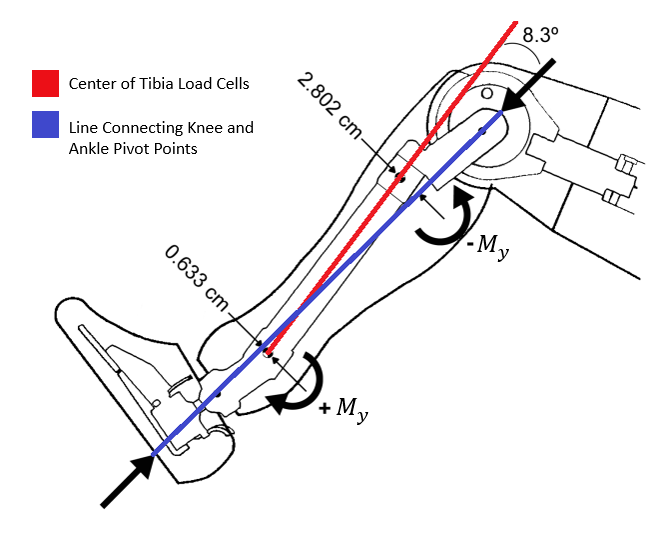
| Apply Moment Correction | Off | Applies the load-cell-location tibia moment correction |
How WebSAT processes the data
- Validate the X-moment, Y-moment, and Z-force channels at the same tibia attachment.
- Convert force and moment inputs to standard units.
- Filter the three channels when
Apply Filteris on. - Correct the bending moments when
Apply Moment Correctionis on.
For a Hybrid III 50th male, WebSAT applies these Y-moment corrections [4]:
The setting has no effect when WebSAT does not have a correction distance for the selected ATD.
- Calculate resultant bending moment:
- Select the ATD-specific critical moment and force values.
- Calculate Tibia Index at every time sample:
- Find the maximum TI and its time.
- Report the maximum index with the governing force and moment information.
Reference values and injury risk
The Hybrid III intercepts follow SAE J1727 and the published ATD IARVs, while the THOR intercepts follow the THOR injury-criteria report [1] [2] [3].
| ATD | Force intercept (kN) | Moment intercept (N·m) |
|---|---|---|
| Hybrid III 95th male | 44.1 | 306 |
| Hybrid III 50th male | 35.9 | 225 |
| Hybrid III 5th female | 22.9 | 114 |
| THOR 50th male | 12.0 | 240 |
| THOR 5th female | 8.6 | 146 |
For THOR, WebSAT reports AIS 2+ risk from both the revised Tibia Index and the peak resultant tibia moment using the THOR Weibull relationships [3]:
Other supported ATDs receive TI and intercept output without those probabilities.
Results
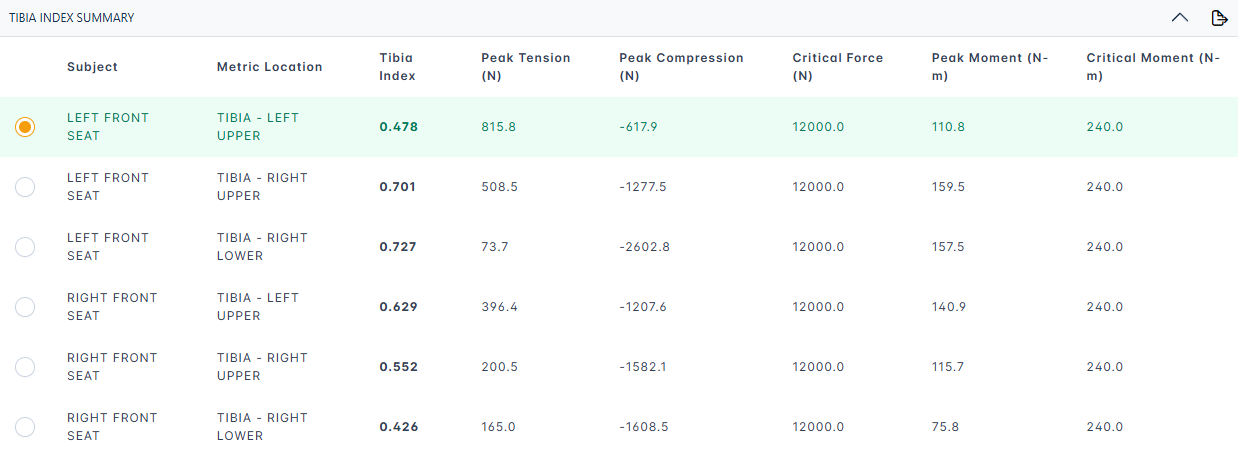
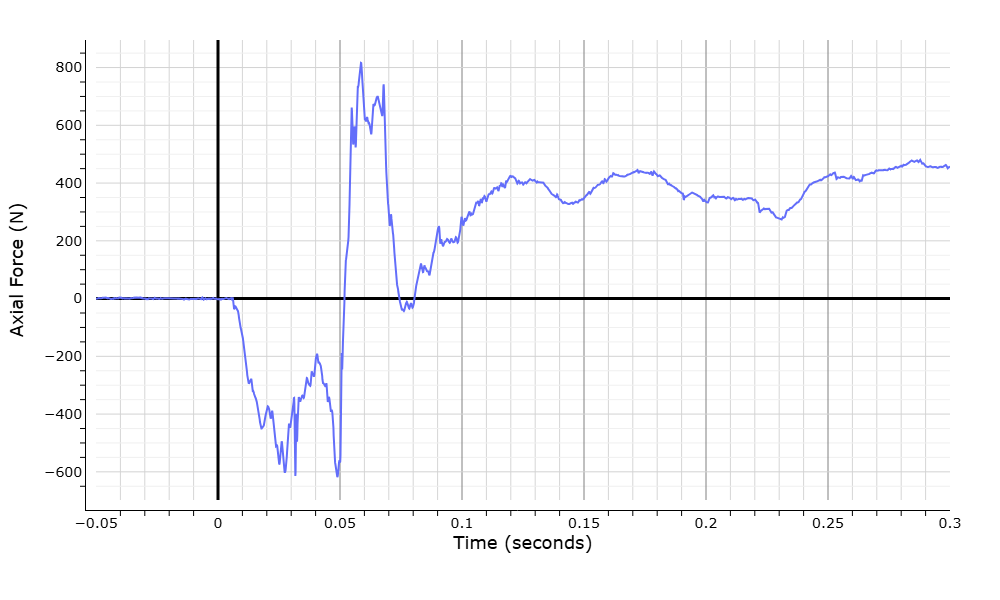
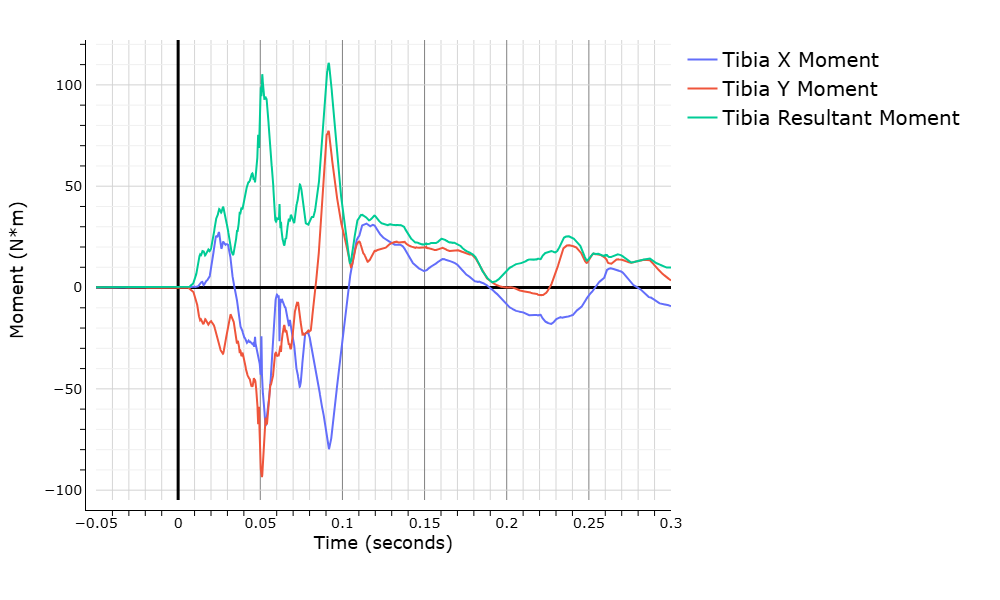
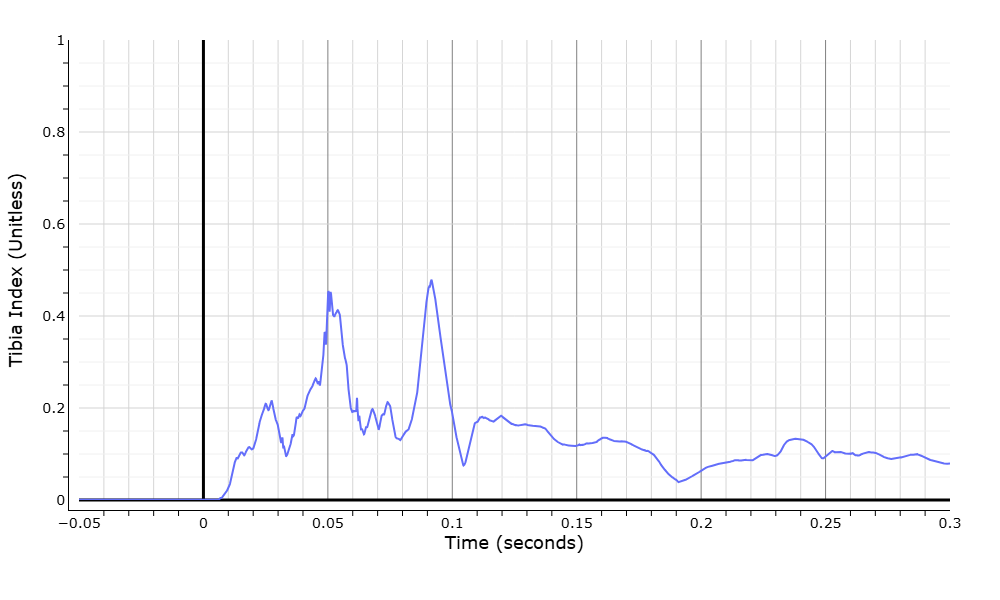
The summary reports the tibia location, peak tension/compression, peak resultant moment, force and moment intercepts, TI, and available THOR AIS 2+ risks.
References
[1] SAE International. Calculation Guidelines for Impact Testing. SAE Recommended Practice J1727.
[2] Mertz, H. J., Irwin, A. L., and Prasad, P. “Biomechanical and Scaling Bases for Frontal and Side Impact Injury Assessment Reference Values.” Stapp Car Crash Journal, 47, 2003, pp. 155–188. SAE Technical Paper 2003-22-0009.
[3] Craig, M. et al. Injury Criteria for the THOR 50th Male ATD. National Highway Traffic Safety Administration, 2020.
[4] Zuby, D. S., Nolan, J. M., and Sherwood, C. P. "Effect of Hybrid III Leg Geometry on Upper Tibia Bending Moments." SAE Transactions, 2001, pp. 177-189.