Lower Spine Acceleration
Description
The lower spine refers to the region of the spine around the lumbar vertebrae, typically extending from the lumbar vertebrae down to the sacrum and pelvis [1]. In car crash scenarios, the lower spine may undergo significant acceleration, which can lead to spinal injuries such as fractures, sprains, or more severe damage to the spinal cord [2]. Additionally, if an Injury Assessment Reference Value (IARV) is associated with the ATD used in the selected load test, the calculated maximum lower spine acceleration will be reported as a percentage of the IARV [3]. The IARV is a threshold value used to assess injury risk during an impact. Each ATD has its own IARV, which varies depending on the type, sex, and size of the dummy [3].
This metric does not have a separate button. WebSAT reports lower-spine acceleration as part of the result when you select Injury Metrics > TTI.
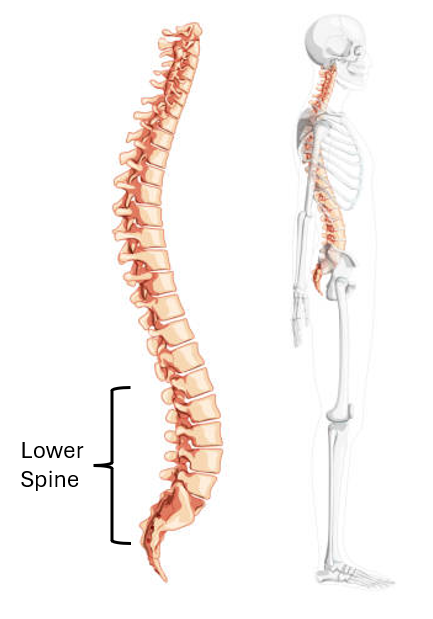
Measurements used by WebSAT
- Acceleration at the Lower Spine (Y)
How WebSAT processes the data
- Convert the lower spine acceleration to gravity (g) (if applicable)
- Filter the acceleration signal (CFC 180)
- Truncate acceleration signal to start at 0 seconds (if applicable)
- Calculate the maximum filtered acceleration value over a 3 millisecond window
- 3 millisecond window is used to better detect the rapid changes in acceleration
- Calculate the percent of the IARV threshold that the maximum filtered acceleration value reaches
Reference values and injury risk
| ATD | IARV (gravity) |
|---|---|
| HIII – 3yo | 92 |
| HIII – 6yo | 60 |
| HIII – 10yo | 82 |
| HIII – F05 | 60 |
| HIII – M50 | 60 |
| HIII – M95 | 54 |
| BioSID | 60 |
| EuroSID (ES-2re) | 82 |
References
[1] Sattar MH, Guthrie ST. Anatomy, Back, Sacral Vertebrae. [Updated 2023 Jul 30]. In: StatPearls [Internet]. Treasure Island (FL): StatPearls Publishing; 2025 Jan.
[2] Yoganandan N, Stemper BD, Baisden JL, Pintar FA, Paskoff GR, Shender BS. Effects of acceleration level on lumbar spine injuries in military populations. Spine J. 2015 Jun 1;15(6):1318-24.
[3] "Frontal Offset Crashworthiness Evaluation - Guidelines for Rating Injury Measures" No. 2009-06. Insurance Institute for Highway Safety (IIHS), 2009.
[4] Mertz, H. J., Irwin, A. L., and Prasad, P. “Biomechanical and Scaling Bases for Frontal and Side Impact Injury Assessment Reference Values.” Stapp Car Crash Journal, 47, 2003, pp. 155–188. SAE Technical Paper 2003-22-0009.