Femur Force
Description
Femur Force reports the peak axial compressive load in a left or right femur and compares it with the occupant's available injury assessment reference value. Supported ATDs also receive an AIS 2+ femur-injury probability [1] [2].
When this feature is available
Femur Force becomes available when either the current curve selection or any loaded test contains a femur measurement set that meets the requirements. Only channels with a usable data status count.
The required measurement set includes:
- The signal attachment must be
FEMUR - LEFTorFEMUR - RIGHT. - The group must contain a force channel with:
- Axis:
Z - LOCAL - Units:
NEWTONS
- Axis:
WebSAT checks each femur independently and enables Femur Force if any left- or right-side measurement set contains the required channel.
Settings
This feature has no settings.
How WebSAT processes the data
- Validate the left- or right-femur Z-force channel.
- Convert the force signal to newtons.
- Filter the signal at CFC 600.
- Trim pre-zero data when it is present.
- Apply the expected compression polarity.
- Find the peak compressive force and its time.
- Compare the peak with the occupant's ATD-specific IARV.
- Report the peak, percent of IARV, and AIS 2+ probability when supported.
Reference values and injury risk
The Hybrid III values follow the published ATD IARVs, and the THOR value follows the THOR injury-criteria report [4] [5].
| ATD | Femur compression IARV (N) |
|---|---|
| Hybrid III 5th female | -6805 |
| Hybrid III 50th male | -10008 |
| Hybrid III 95th male | -12700 |
| Hybrid III 6-year-old | -2310 |
| THOR 50th male | -10577 |
| THOR 5th female | -6510 |
A negative sign denotes compression in the ATD coordinate convention. WebSAT compares force magnitudes when calculating percent of IARV.
Hybrid III 50th male and 5th female use the NCAP AIS 2+ logistic relationships. For THOR, WebSAT uses the peak compressive femur force in kilonewtons in this AIS 2+ relationship [3] [4]:
WebSAT leaves probability blank for unsupported ATDs.
Results
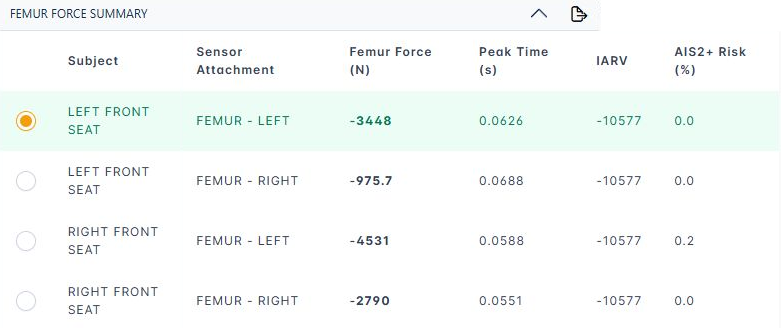
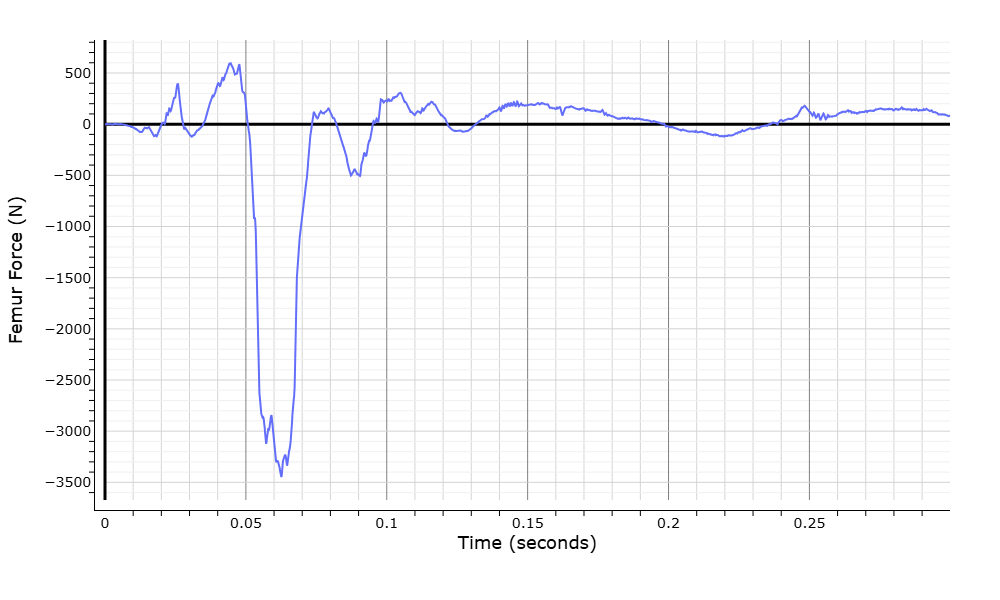
The summary reports test, occupant, left/right attachment, peak compression, peak time, IARV, percent of IARV, and AIS 2+ probability. The detail plot shows the filtered femur-force history and peak.
References
[1] Insurance Institute for Highway Safety. Frontal Offset Crashworthiness Evaluation—Guidelines for Rating Injury Measures, 2009.
[2] Eppinger, R. et al. Development of Improved Injury Criteria for the Assessment of Advanced Automotive Restraint Systems: II, 1999.
[3] National Highway Traffic Safety Administration. Federal Motor Vehicle Safety Standards; Occupant Crash Protection; Final Rule. Federal Register, 65(208), 2000.
[4] Craig, M. et al. Injury Criteria for the THOR 50th Male ATD. National Highway Traffic Safety Administration, 2020.
[5] Mertz, H. J., Irwin, A. L., and Prasad, P. “Biomechanical and Scaling Bases for Frontal and Side Impact Injury Assessment Reference Values.” Stapp Car Crash Journal, 47, 2003, pp. 155–188. SAE Technical Paper 2003-22-0009.